Group: Members
Posts: 306
Member No.: 16889
Joined: January 15, 2019
I really doubt that the locations (coordinates) indicated in the Guide always reflect the actual sites where fish samples were taken. Sure, for the small lakes it is obvious, but for the big lakes and rivers I am pretty sure it is not. Then, we don’t know when the samples were taken. They say fish is tested “periodically” but don’t disclose what it means. I had contacted MECP asking them to indicate the date of the sample for each location but I really doubt they are going to listen.
What do I mean by ‘Common sense’? Try your best to eat fish from the most clean location, try not go over the limit indicated in the Guide. Special concern is for pregnant women and children, but much less for older folks. But you need to understand that we still need to eat fish, as we need all these omega 3,6 etc. And if you buy fish in the store or use supplements (with all raw materials most likely coming from China or India) you just don’t know what you are taking. It is pretty much the same as people here some 20 years ago, before the testing program started, were fishing and eating the fish without any idea what crap was in it. But - sure enough - at that time the level of mercury and PCB was higher than now (PCB was banned in 1970-1980, as I recall). People have lived their lives and many still live and are happy (or not). No one has a solution here, humans have contaminated the planet extremely heavily but life is going on…
Group: Members
Posts: 4145
Member No.: 18589
Joined: September 15, 2020
QUOTE (MarkDv @ Jun 24, 2025 - 01:48 pm)
I really doubt that the locations (coordinates) indicated in the Guide always reflect the actual sites where fish samples were taken. Sure, for the small lakes it is obvious, but for the big lakes and rivers I am pretty sure it is not. Then, we don’t know when the samples were taken. They say fish is tested “periodically” but don’t disclose what it means. I had contacted MECP asking them to indicate the date of the sample for each location but I really doubt they are going to listen.
What do I mean by ‘Common sense’? Try your best to eat fish from the most clean location, try not go over the limit indicated in the Guide. Special concern is for pregnant women and children, but much less for older folks. But you need to understand that we still need to eat fish, as we need all these omega 3,6 etc. And if you buy fish in the store or use supplements (with all raw materials most likely coming from China or India) you just don’t know what you are taking. It is pretty much the same as people here some 20 years ago, before the testing program started, were fishing and eating the fish without any idea what crap was in it. But - sure enough - at that time the level of mercury and PCB was higher than now (PCB was banned in 1970-1980, as I recall). People have lived their lives and many still live and are happy (or not). No one has a solution here, humans have contaminated the planet extremely heavily but life is going on…
You are correct that PCBs were banned, but in Canada there is still unhealthy levels in many areas because of the way they were disposed. Other countries still use PCBs and travel through the air and land wherever the jet stream drops them in Canada. There are still PCBs in older buildings etc. in Canada. Mercury levels are lower in many areas than they were 50 years ago. But in some areas, Mercury levels are rising. Also water testing in the Great Lakes etc. for chemicals started when I was around 10 years old. That was 50 years ago, not 20 years ago. And Mercury is still at the top of the list for testing.We knew way back then that eating fish and animals that contained contaminants was bad for our health. So some chemicals were banned or used in less concentrations. Then we invented even worse toxic chemicals like PFAS (Forever Chemicals) now many of those are being banned. Again, you are right that humans have contaminated our world. Some are trying to clean it up, but many are still finding short cuts that have consequences. Can we save the planet? Probably not. But I think it will last at least another 500 to 1000 years. Then it might just pop like a balloon. The optimistic thought is maybe we can save it. I have always been an optimist. I am a fisherman. I believe, I believe, I believe.
Group: Newbies
Posts: 16
Member No.: 20988
Joined: June 21, 2025
I think most anglers believe that if the contamination were really serious, there would be obvious public warnings—signs posted, press releases, news stories. But that’s simply not how it works in Ontario.
Instead, the Guide to Eating Ontario Fish (available online) is considered the official source. The government believes that publishing the data there is enough—and the responsibility falls to the angler to find, understand, and follow the Guide’s advice.
So let’s take a look at what it actually says.
At the station listed as “Nottawasaga River (44°28'57"N, 79°59'56"W)”, children and women of childbearing age are advised to eat ZERO meals per month of:
• walleye • yellow perch • rainbow trout • smallmouth bass • black crappie • northern pike • rock bass • pumpkinseed • redhorse sucker • white sucker • common carp • chinook salmon
In short: 12 of the 13 species tested at this location are now classified as “do not eat” fish for children and women of childbearing age.
In the majority of cases, this is because of PFAS contamination—a class of industrial chemicals linked to immune suppression, hormone disruption, and reduced reproductive success. The source is well established: firefighting foam from the training school at CFB Borden, which flows into Bear Creek, then into the Pine River, and then into the Nottawasaga River. The full contamination pathway is over 46.6 km long, extending through Jack’s Lake and continuing downstream.
The Guide is telling you that these fish are not safe to eat—not even a few times a year—for children or women who are pregnant or could become pregnant. That’s not just a minor advisory. It’s a serious warning buried in a spreadsheet.
“With great power there must also come—great responsibility.”
Anglers have the power to bring home food for their families. But with that comes the responsibility to make informed choices—especially when feeding vulnerable people.
You don’t have to take my word for it. Just read the Guide. The facts are there for anyone willing to look.
Group: Members
Posts: 3860
Member No.: 25
Joined: February 10, 2011
QUOTE (ilikepike @ Jun 25, 2025 - 11:58 am)
Anglers have the power to bring home food for their families. But with that comes the responsibility to make informed choices—especially when feeding vulnerable people.
You don’t have to take my word for it. Just read the Guide. The facts are there for anyone willing to look.
Last 2 sentences pretty much covers it. "I don't know" or "nobody told me" is pretty much ignorance. Sounds like those that buy a new car and don't know how it works but they give you a 300 page explicit manual.
Group: Members
Posts: 306
Member No.: 16889
Joined: January 15, 2019
I was thinking this topic is over for me but could not resist and did a quick search in PubMed. But I was more interested in PCBs, not in PFAS because … oh, well that’s another story,… Sorry for cluttering the initial topic but it is related.
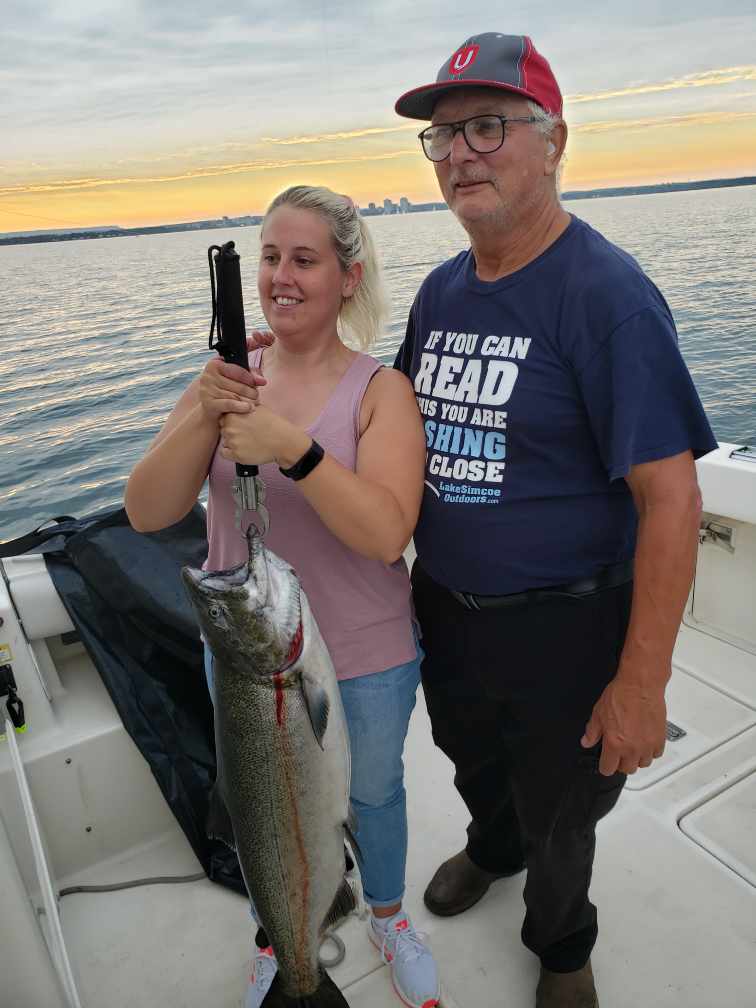
We went GB fishing yesterday and for the first time in two years we got a salmon. Unfortunately, it was huge. 15 lb, 85 cm. If I would be alone I would release it without any attempt to bring it to the boat. But as I humbly asked my wife “Let’s release it”, she was vigorously decisive: “I won’t ever go fishing with you if you release it”. Ok, we took it and we are going to eat it. A lot. So, this is my “common sense’. I know it’s apparently not very good for our health even though it's not dramatically destructive. But I want to enjoy my lifestyle, I want my wife to go fishing with me and I do accept some health risk for that.
Now, come back to my quick search about PCB. I was … not entirely surprised but rather surprisingly found info to confirm that I was long thinking about. This study https://pmc.ncbi.nlm.nih.gov/articles/PMC1566611/ found that: Comparisons with available international data on adipose tissue levels reveal that the organochlorine body burden in the Inuit population of Greenland is presently among the highest resulting from environmental exposure. Imagine: these folks in Greenland are living in the apparently cleanest and least polluted environment in the world and still consume a lot of crap. And you are talking about Filet-O-Fish from McD's!
Group: Newbies
Posts: 16
Member No.: 20988
Joined: June 21, 2025
It is deeply unfair that Inuit communities in Greenland are contaminated by organochlorines released into the environment by people living thousands of kilometres away.
Here in Ontario, we’re fortunate to have a tool—the Guide to Eating Ontario Fish—that tracks contaminants in local fish and offers science-based consumption advice.
That matters, because contamination levels vary dramatically from place to place. If you care about the health of your family, especially children and women of childbearing age, the Guide can help you avoid high-risk areas and choose safer fish to eat.
One area to be avoided is the Nottawasaga River (44°28'57"N, 79°59'56"W).
According to the 2024 edition of the Guide, all sizes of the following 12 species are classified as highly contaminated “do not eat” fish for children and women of childbearing age: walleye, yellow perch, rainbow trout, smallmouth bass, black crappie, northern pike, rock bass, pumpkinseed, redhorse sucker, white sucker, common carp, and chinook salmon.
In most cases, the contaminant of concern is PFAS, a class of chemicals that persist for years in water, soil, wildlife, and people. The source in this case is the fire training school at CFB Borden, more than 46 km upstream, which discharged PFAS-laden foam into the watershed. The PFAS flows into Bear Creek, then the Pine River, and finally into the Nottawasaga River.
Please consult the Guide to Eating Ontario Fish before eating—or feeding anyone—fish from this region.
Group: Members
Posts: 306
Member No.: 16889
Joined: January 15, 2019
QUOTE
...Inuit communities in Greenland are contaminated by organochlorines released into the environment by people living thousands of kilometres away.
Yes, this is how it appeared from the article and it was my initial impression. But the more I think about it, the more I tend to believe that the PCBs in Inuit's tissues do not necessarily come only directly from the animal fats they are consumed in high volume. It may come from what’s called non-Aroclor sources (Aroclor is the actual PCB products used in the past in big volumes and banned in the 1980s, so non-Aroclor sources are those PCBs, which are not produced intentionally in big volumes), such as paints, food packaging and other plastics people use around. These non-Aroclor sources are considered sometimes to be the main source of PCBs accumulation in human tissues. For example, I very often see on this and other forums the pictures when people fillet their fish on the old newspaper. To me it looks both aesthetically disgusting, not respectful to fish they catch and a way to add some extra crap to the fish they consume. So the point here is that PCBs and other contaminants are everywhere. 'Common sense' for me is to be aware and vigilant, to try to eliminate it from any possible sources but at the same time not to be hysterical about it. No matter what we do we are still getting some.
Group: Newbies
Posts: 16
Member No.: 20988
Joined: June 21, 2025
Current scientific understanding is that PCBs, being non-ionic and semi-volatile, can travel long distances in the atmosphere before depositing in cold regions like the Arctic. There, they bioaccumulate in food chains, with Inuit exposure primarily coming from the consumption of marine mammals high on those chains.
Returning to the topic of this thread—“Nottawasaga contaminants issues”—the primary cause of the highly contaminated “do not eat” fish advisories on the Nottawasaga River (44°28′57″N, 79°59′56″W) is PFAS, not PCBs.
The source of this PFAS is well-established: the fire training school at CFB Borden. Contaminated runoff flows into Bear Creek, travels 2.6 km downstream to the Pine River, continues another 11.1 km to the Nottawasaga River, and then flows 32.9 km further to Jacks Lake—creating a 46.6 km contaminated corridor.
Because PFAS compounds like PFOS are non-volatile, they tend to remain in water and sediment rather than dispersing through the atmosphere. As a result, PFAS contamination is largely confined to this defined watercourse, while nearby waterways are comparatively unaffected.
By following the guidance in the Guide to Eating Ontario Fish, anglers can significantly reduce their exposure to PFAS. For the Nottawasaga River at 44°28′57″N, 79°59′56″W, the Guide currently advises that children and women of childbearing age should eat ZERO meals per month of the following species, due to high contamination:
Group: Newbies
Posts: 16
Member No.: 20988
Joined: June 21, 2025
It’s worth remembering that not all waters are equally contaminated.
That’s why the Guide to Eating Ontario Fish (available online) is such an important resource. It lets anglers make informed choices—avoiding fish from known contamination hotspots while still enjoying fish from cleaner waters.
The 2024 edition of the Guide contains data from 2,765 tested locations across Ontario. Contamination levels vary widely. In moderately contaminated areas, smaller individuals of a species (like pike) are often safer to eat than larger ones. But in highly contaminated areas, even the smallest fish of a species may be unsafe—resulting in a “do not eat” advisory for all sizes.
There are only three locations in Ontario where more than 7 species of fish are designated “do not eat” for children and women of childbearing age:
• Binbrook Reservoir (Welland River) – 10 species
• Port Davidson Conservation Area (Welland River) – 11 species
• Nottawasaga River (Jack’s Lake area) – 12 species
These are among the worst-contaminated spots in the province. I personally would not eat fish from those waters—and I certainly wouldn’t serve them to my family.
But the good news is this: most of Ontario’s waters aren’t this badly contaminated. If you check the Guide, you’ll find many places where advisories are far less severe.
In short, we haven’t wrecked everything. But to protect yourself and your family, it’s wise to check the Guide before eating what you catch—especially if you’re feeding kids or women of childbearing age.
Group: Members
Posts: 3860
Member No.: 25
Joined: February 10, 2011
Yes it's beyond sad for sure. I wonder how long it will take for that crap the Fire Academy dumped into the land beside Bear Creek will take to go away if it ever does. Reminds me of the "Love canal" around the Niagara River that was/is a disaster.
Georgian Bay & Lake Huron
Fishing forum for Lake Huron & Georgian Bay. Fishing for walleye, muskie, bass, salmon, trout, crappie, perch and more. Local Fishing Reports, Current Ice Conditions, Fishing Tips, Tactics, Discussions & More. Enjoy Lake Huron Outdoors!
Fishing Lake Huron & Georgian Bay Forum : Fishing Tips, Current Conditions, Fishing Reports & more! Fishing Lake Huron & Georgian Bay Forum



 Nottawasaga contaminants issues, Eulogy for the Pike Infested Swamp